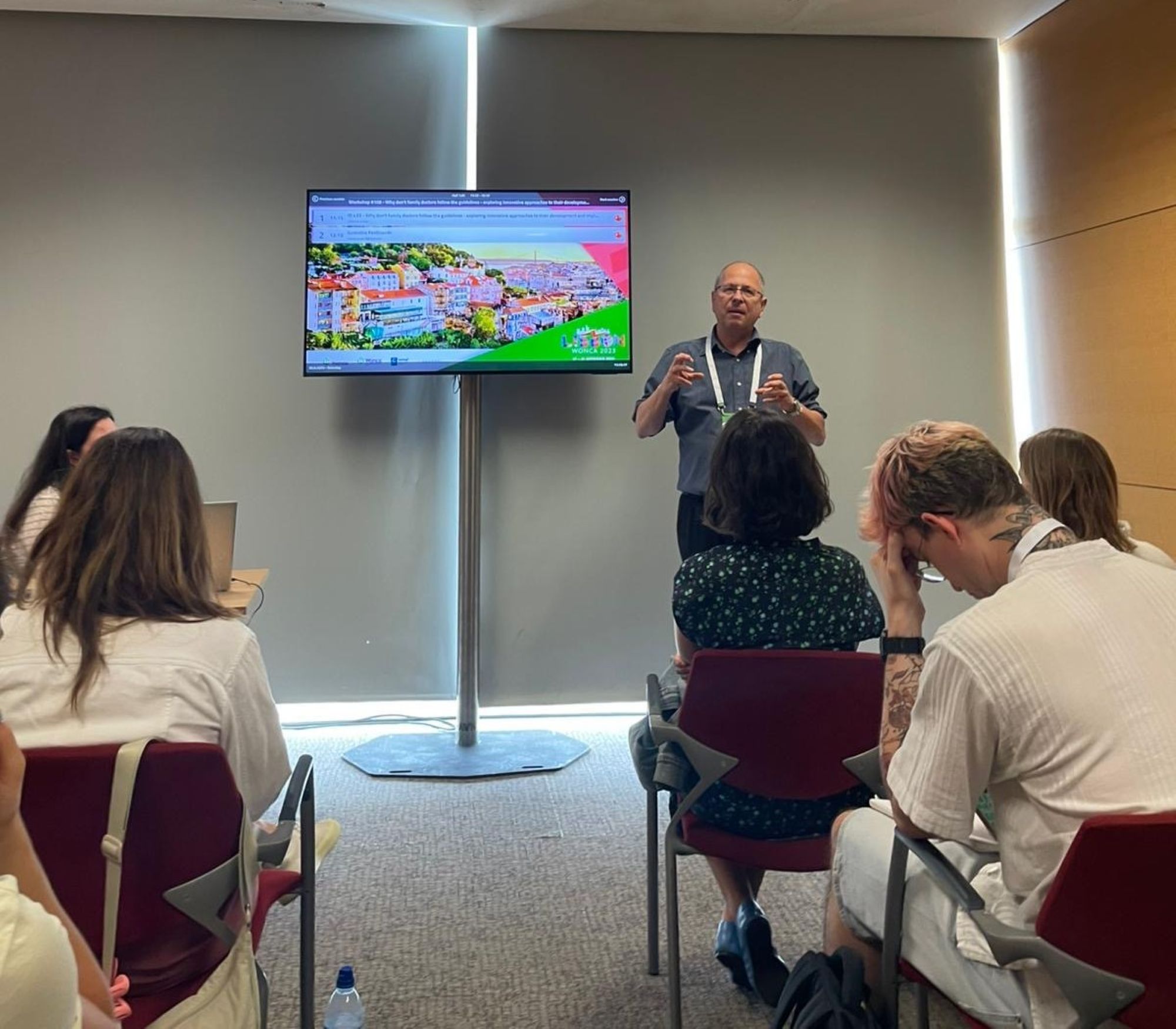
At the WONCA Europe 2025 Conference in Lisbon, POINT hosted a dynamic workshop titled “Why don’t family doctors follow the guidelines? Exploring innovative approaches to their development and implementation.” The session, held on 20 September, sparked lively debate among general practitioners, researchers, and health policy experts about how clinical guidelines can better serve the realities of primary care.
The discussion began with a live poll where participants identified barriers to guideline use. Time pressures, overly complex documents, and the sheer number of guidelines emerged as recurrent frustrations. Attendees also pointed to deeper issues: many guidelines are not adapted to the multimorbidity that dominates family practice, are difficult to access at the point of care, or feel disconnected from the everyday constraints of local health systems.
Speakers framed these challenges in a wider context. While hospitals often deal with single conditions in controlled settings, family doctors manage patients with multiple chronic diseases, limited resources, and highly individual care trajectories. Randomised trials – the backbone of many guidelines – rarely reflect this complexity. As one participant noted, “about us, without us” has become a recurring flaw in how guidance is developed for primary care.
The workshop was not just about critique but also about co-creation. Small groups reviewed draft materials linked to POINT’s research and suggested implementations of different aspects, drawing on their experiences in rural, urban, and resource-limited contexts. Discussions highlighted the importance of person-centred care over rigid performance targets, the need for guidance that is both accessible and pragmatic, and the potential of digital tools and AI when designed as supports rather than replacements for clinical judgment.
By the end of the session, the facilitators had collected annotated questionnaires and a rich set of insights that will directly inform the next phase of the POINT project. A follow-up workshop is planned to refine these tools further before they are finalised and tested.
The Lisbon workshop demonstrated the power of involving family doctors directly in shaping the frameworks that govern their work. For the POINT consortium, it reinforced a central conviction: guidelines that ignore frontline realities will never achieve their intended impact, but those co-designed with practitioners can become true engines of change in European primary care.